Last Updated Apr 22, 2026
Keyword Cannibalization: Diagnosing Intent Overlap and Consolidating Content
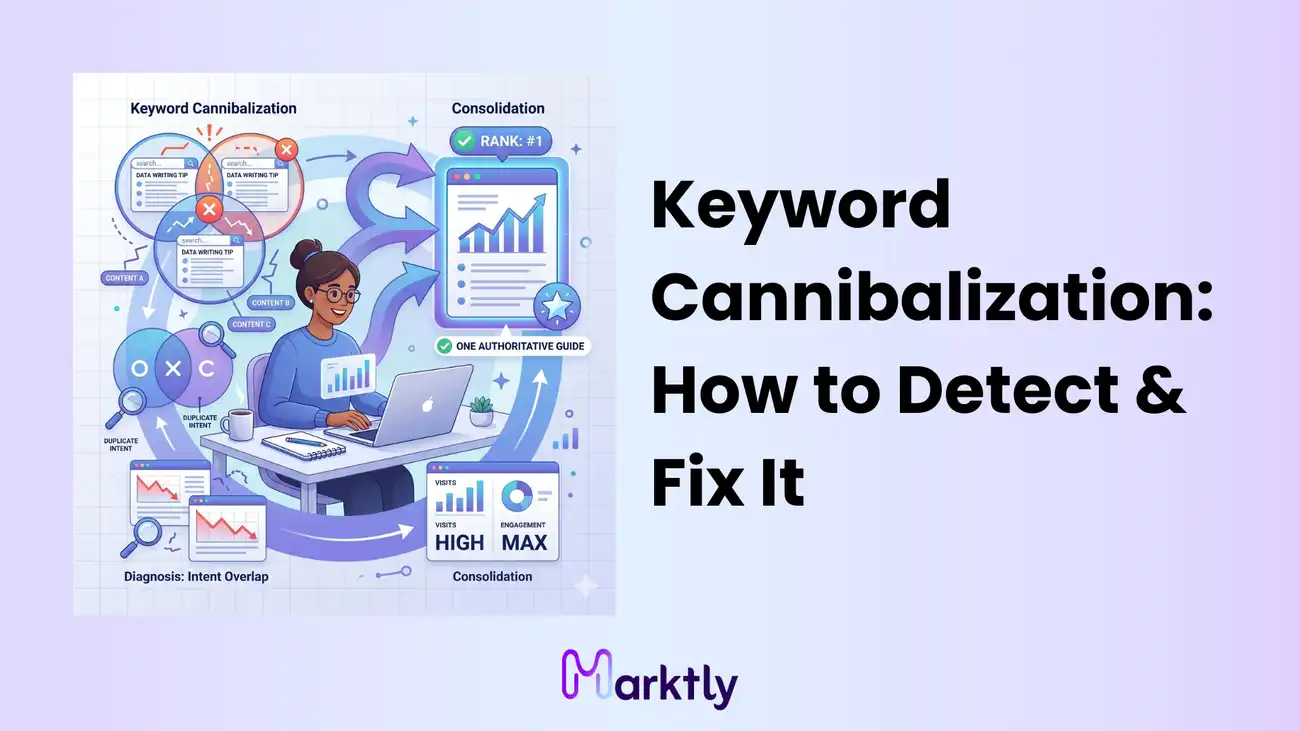
Here’s something that confuses a lot of site owners: your rankings keep jumping around up one week, down the next and you can’t figure out why. No algorithm update. No lost backlinks. The result is inconsistent performance. That’s often keyword cannibalization at work. But here’s what most guides get wrong about it: cannibalization isn’t just “two pages ranking for the same keyword.” It’s two pages fighting for the same search intent and that’s a very different problem.
Misdiagnosing cannibalization is costly because it can lead to deleting high-performing pages or misallocating link equity. Site owners often delete pages that are already performing well, such as pages generating traffic or conversions. They redirect URLs that had real link equity. They fix things that weren’t broken. So before you touch anything, you need to know exactly what you’re dealing with.
This article walks you through how to correctly diagnose keyword cannibalization using Google Search Console (for free), how to evaluate whether you actually have a problem, and the specific technical steps to resolve it: 301 redirects, canonical tags, and intent shifting.
What Is Keyword Cannibalization?
Keyword cannibalization happens when multiple URLs on the same domain compete for the exact same search intent. Not just the same keyword with the same intent.
When that happens, search engines like Google get confused. Instead of picking a winner and pushing it to the top, they split ranking signals between both pages. Competing pages split ranking signals, reducing the overall strength each page can achieve. Five external sites linking across two competing pages divide the available link equity between them. Neither URL gets the consolidated authority required to consistently hold a top position. One consolidated page typically outperforms two competing pages because it concentrates link equity, relevance, and ranking signals.
Is Keyword Cannibalization Always Bad?
No and this is where most SEO advice goes off track.
Two URLs ranking for the same keyword is not cannibalization when they serve different search intents. That’s SERP domination. And you should protect it, not fix it.
Here’s a clear example:
- A blog post answering “what is project management software” (informational intent)
- A product page letting users sign up for your project management tool (transactional intent)
Both ranking for “project management software”? That’s healthy. Two different users, two different needs, two different pages doing their jobs.
So the rule is simple:
- Both pages fulfill distinct user journeys → Keep both. Don’t touch them.
- Both pages satisfy the same user need → That’s true cannibalization. Fix it.
Never consolidate pages just because they share a keyword. Always check whether both pages contribute unique conversions or serve different visitor stages. If they do, leave them alone.
How to Detect Keyword Cannibalization in Google Search Console
Many SEO guides recommend running a site:yourdomain.com "keyword" search, such as basic blog tutorials on keyword audits. That works for one keyword. It doesn’t scale to hundreds of pages.
A more effective method is using GSC’s raw query data combined with a pivot table. No paid tools needed.
Here’s how to do it:
-
Export your GSC query data. Go to Search Console → Performance → Search Results. Set the date range to the last 6 months. Click “Pages” then export all data to a spreadsheet (Google Sheets or Excel both work).
-
Build a pivot table grouped by query. In your spreadsheet, create a pivot table with “Query” as the row and “Page” as the value. This instantly shows you every query that’s driving traffic to more than one URL. Filter for queries mapped to three or more distinct pages; those are your highest-risk candidates.
-
Check impressions and CTR for each conflicting URL. The key signal is multiple pages splitting impressions for the same query while both experience declining CTR. That declining CTR is the tell. It means Google is rotating between the pages and users aren’t consistently clicking either. This method works because it relies on actual query, impression, and CTR data from Google, rather than assumptions based on content similarity.
Workflows to Resolve Keyword Cannibalization
Once you’ve confirmed a real problem, you have three options. The one you pick depends on the pages involved and how much link equity is at stake.
Consolidate Content and Apply 301 Redirects
Merge pages that target identical search intent, meaning the same topic, user need, and stage of the journey.
Take the strongest page (usually the one with more backlinks, higher average position, or more conversions) and call it the primary URL. Move any unique, genuinely useful information from the weaker pages into this primary URL. Don’t copy-paste; integrate the content so the page becomes more comprehensive.
Then implement a 301 permanent redirect from each secondary URL to the primary. A 301 transfers the historical link equity and ranking signals to the destination. This is how you preserve the authority those secondary pages built up over time instead of abandoning it.
One step people forget: audit your internal links. After redirecting, update all internal links across the site to point directly to the primary URL not through the redirect. Redirect chains slow crawling and dilute equity over time. Go straight to the source.
Implement Canonical Tags for Necessary Duplicates
Sometimes you can’t redirect a page because users still need direct access to it like parameterized filter pages on an ecommerce site. Deleting or redirecting them would break the user experience.
In that case, use a canonical tag instead of a redirect. Add the rel="canonical" attribute to the duplicate or parameterized page, pointing to the main category or primary URL. This tells Google: “this page exists for users, but consolidates the ranking power over there.”
A real example: if your site generates URLs like /shoes?color=blue and /shoes?color=red alongside /shoes, add a canonical on each parameter page pointing to /shoes. Google consolidates authority to the main page while users can still filter by color.
Shift Search Intent to Differentiate Content
When a secondary page has strong backlinks, do not merge it. Instead, reposition it to target a different search intent.
Rewrite the content so it targets a highly specific long-tail variation or a different stage of the buyer’s journey. For instance, if the primary page targets “email marketing strategy” (broad informational intent), rewrite the secondary page to target “email marketing strategy for SaaS onboarding sequences” (specific, late-funnel intent). Now they’re no longer competing.
This only works if the page has real equity worth preserving backlinks, traffic, domain authority signals. Don’t do this for thin pages.
Once you’ve shifted the content angle, update the Title Tag, H1, and on-page semantic phrasing to strictly reflect the new intent. Leaving old metadata in place will confuse both Google and users.
Preventing Cannibalization Through Content Architecture
The best fix for cannibalization is not creating it in the first place.
The way to do that is with a centralized keyword map, a document (a spreadsheet works fine) that assigns one primary intent cluster to one specific URL. Before any new article goes into production, the content team checks the map. When an intent is already claimed by an existing URL, the new article either gets merged into the existing piece or repositioned to target a differentiated intent.
Beyond that, run a quarterly content audit using the site:domain.com "keyword" search operator before commissioning new content. It takes 10 minutes and can save you from spending weeks later cleaning up conflicts. You’re looking for any existing indexed page that’s already targeting the same core topic. If one exists, strengthen it, don’t duplicate it.
Wrapping Up
Keyword cannibalization is one of those problems that’s easy to misdiagnose and expensive to fix incorrectly. The real issue isn’t two pages sharing a keyword, it’s two pages fighting for the same user intent.
Here’s the short version of everything covered:
- Not all overlap is bad. Mixed-intent SERPs reward multiple rankings. Don’t delete pages that are working.
- Use GSC pivot tables to detect at scale. Splitting impressions plus declining CTR is your signal.
- Match the fix to the situation. Identical intent → 301 + merge. Necessary duplicate → canonical. Valuable secondary page → reposition the intent.
- Prevent it going forward with a keyword map and quarterly audits.
If you’re starting today, export your GSC data, build that pivot table, and find your three worst-offending queries. Start there. Fix one cluster before touching another. And before you redirect or delete anything, check the backlink profile of the page you’re consolidating that link equity is worth preserving.
Read More Articles



Ready to create content with Marktly?
Start publishing smarter with AI-powered content workflows and seamless CMS integrations. Everything you need to go live