Last Updated Apr 15, 2026
How to Do Keyword Research: Map Intent, Calculate Potential, Drive Revenue

Keyword research is the process of aligning what people search for with what actually makes your business money. Not just traffic revenue.
Here’s the uncomfortable truth: 90.63% of pages get zero organic traffic (Ahrefs study). That usually happens because people chase keywords without validating intent or value.
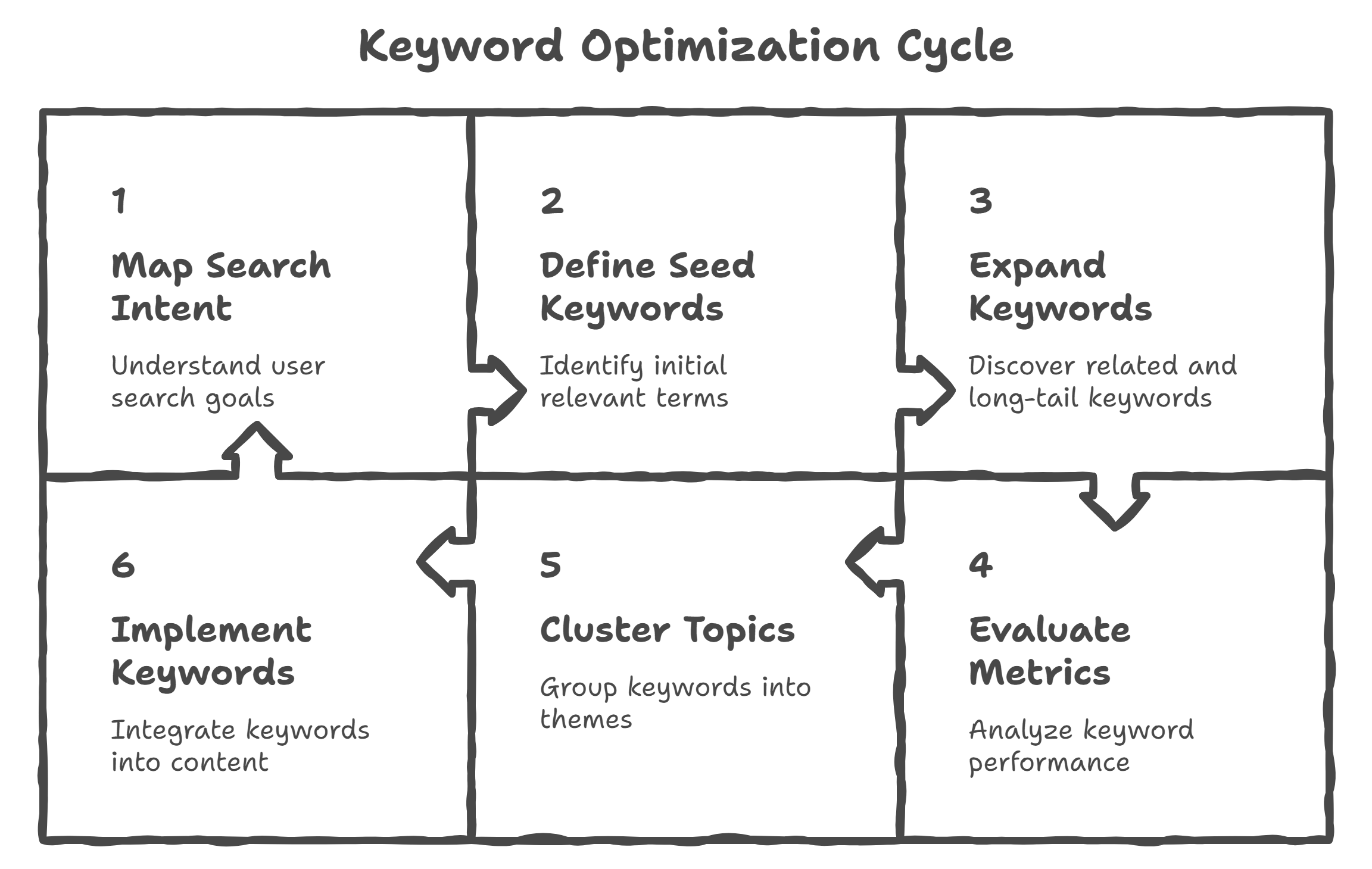
I’ve seen this a lot: teams obsess over search volume, publish content, and then… nothing. No clicks, no leads, no sales. So in this guide, I’ll show you a practical workflow:
- how to map intent to the right content
- where to find real keywords (not just tool suggestions)
- how to evaluate what’s worth targeting
- and how to avoid wasting time on vanity metrics
Following this process removes guesswork and leads to decisions that drive revenue.
Map Search Intent to Funnel Stages
Before you even think about keywords, you need to answer this:
What does the searcher actually want?
→ Why does this matter? Because misaligned intent cannot be corrected with SEO alone.
Search intent falls into four categories:
- Informational intent → People want to learn something
→ Map this to top-of-funnel blog posts (guides, how-tos, tutorials) - Navigational intent → People want a specific brand or website
→ Usually not worth targeting unless it’s your own brand - Commercial intent → People are comparing options
→ Map this to middle-of-funnel content (reviews, comparisons, “best tools”) - Transactional intent → People are ready to act
→ Map this to bottom-of-funnel pages (product, service, pricing pages)
A critical point to understand:
A search for “Ahrefs pricing” indicates intent focused on Ahrefs, not alternative providers.
CTR for outsiders is often below 1%, which makes this effort inefficient.
A quick mental shortcut I use:
- “How to…” → informational
- “Best / top / vs” → commercial
- “Buy / price / near me” → transactional
Once intent is mapped, the appropriate content format becomes clear because each intent type aligns with a specific format (e.g., guides, comparisons, or product pages).
Only then does keyword research become meaningful.
Generate and Expand Seed Keywords
Now that you know what kind of content you need, the next step is finding what people are searching for.
1. Define seed keywords
Seed keywords are broad 1–2 word terms that represent your core offering.
Examples:
- “email marketing”
- “running shoes”
- “SEO tools”
Think of them as the roots. Everything else grows from here.
2. Extract low-hanging fruit from GSC
An often overlooked insight:
Your best keywords are often already sitting in your Google Search Console.
Go to GSC → Performance → Queries
Filter by position: 2–15
These are low-hanging fruit keywords because they already rank within positions 2–15 and require minimal optimization to improve visibility.
Why this range?
- You already rank → Google trusts your page
- You’re close → small improvements can push you to page 1 top spots
I’ve seen pages jump from position 8 to 3 with just better headings and internal links. No backlinks needed.
3. Filter high impressions, low clicks
Now add another layer:
Look for queries with:
- high impressions
- low clicks
This means:
- Google shows your page often
- But users aren’t clicking
Why?
Usually one of these:
- weak title/description
- wrong intent match
- poor positioning
Fixing this can give you instant traffic gains without new content.
4. Extract long-tail keywords from communities
Keyword tools are helpful, but they lag behind real user behavior.
Want fresher ideas?
Go where people actually talk:
- Quora
- niche forums
Search your topic and look for:
- repeated questions
- frustrations
- specific use cases
These are long-tail keywords, often with zero search volume in tools.
But don’t ignore them.
Because here’s the thing:
👉 Zero in tools ≠ zero in real life
These are early signals. If you catch them now, you win before competitors even notice.
Evaluate Keyword Metrics Beyond Search Volume
This is where most SEO strategies fail, as decisions are often based solely on search volume without considering traffic potential or conversion value.
Search Volume represents an average monthly estimate of queries; it does not reflect unique users or actual traffic generated.
It doesn’t tell you:
- how many clicks actually happen
- how many keywords a page ranks for
- how much traffic you’ll get
So treating it as “expected traffic” is a mistake.
Traffic Potential is what actually matters.
Instead of asking:
“How many people search for this keyword?”
Ask:
“How much traffic does the top-ranking page get?”
Because that page ranks for hundreds of related keywords, not just one.
Example:
- Keyword: “best running shoes” → 10K volume
- Top page traffic: 120K/month
That gap comes from long-tail variations.
So always analyze the #1 ranking page’s total traffic. That’s your real ceiling.
Keyword Difficulty (KD) measures how many referring domains link to the top results.
In simple terms:
- more backlinks = harder to rank
However, difficulty is relative to your site’s authority.
A keyword that’s “hard” for a new blog might be “easy” for an established site.
So don’t blindly trust KD scores. Compare them to your current backlink profile.
Business Potential is the most ignored metric and the most important.
Use a simple 0–3 scale:
- 0 → no way to mention your product
- 1 → slight mention possible
- 2 → product fits naturally
- 3 → product is the solution
Example:
- “what is SEO” → 0
- “SEO tools comparison” → 3
Focusing only on traffic results in visitors without meaningful conversions.
Prioritizing business potential leads to revenue-generating outcomes.
That is the core objective.
Group Zero-Volume and Long-Tail Clusters
Let’s address a common doubt:
Should you target keywords with zero search volume?
Short answer: yes when structured correctly.
Start with long-tail keywords (3+ words). These usually:
- have lower competition
- show clearer intent
- convert better
Rather than targeting a single zero-volume keyword, group 10–15 related queries with the same intent into a single page to consolidate their combined potential.
Example cluster:
- “best shoes for flat feet running”
- “running shoes for flat feet beginners”
- “affordable flat feet running shoes”
Individually → low or zero volume
Combined → meaningful traffic
This works because Google doesn’t rank pages for single keywords anymore.
It ranks topics.
So one well-structured page can rank for dozens even hundreds of variations.
This is how you turn “tiny keywords” into scalable traffic.
Implement Keywords Without Artificial Stuffing
Now you’ve got your keywords. The final step is using them properly.
Repetition is unnecessary; keywords do not need to appear excessively.
Start with the basics:
Map your primary keyword to:
- title tag
- H1
- URL slug
- introduction
This helps search engines quickly understand your page.
Now let’s clear a common myth:
LSI keywords are not a real SEO factor.
Google’s John Mueller has confirmed this multiple times.
You don’t need to force synonyms like:
- “cheap shoes”
- “affordable footwear”
- “budget sneakers”
Just to “cover LSI.”
What actually works?
👉 Topical coverage
When your content genuinely covers a topic well:
- Google understands context
- Your page ranks for related terms automatically
I’ve seen pages rank for 300+ keywords without mentioning most of them explicitly.
So instead of stuffing keywords, focus on:
- answering real questions
- covering subtopics
- making content useful
Write for people first.
Search engines will follow.
What to Do Next
Let’s recap what we covered:
- You mapped search intent to the right content formats
- You found keywords using GSC, communities, and seed expansion
- You evaluated them using Traffic Potential and Business Potential (not just volume)
- You grouped long-tail and zero-volume queries into clusters
- You implemented keywords without stuffing or outdated tactics
Now here’s the honest part:
Many marketers revert to prioritizing search volume despite understanding its limitations.
Don’t do that.
Instead:
- Open your Google Search Console
- Find keywords in positions 2–15
- Pick one page and optimize it this week
Start small. Test the process. Watch what happens.
If you want better results from SEO, you don’t need more tools.
You need better decisions.
You now have the framework to make those decisions.
Read More Articles



Ready to create content with Marktly?
Start publishing smarter with AI-powered content workflows and seamless CMS integrations. Everything you need to go live