Published Jun 05, 2026
Last Updated Jun 05, 2026
On-Page SEO: What Actually Moves Rankings Today
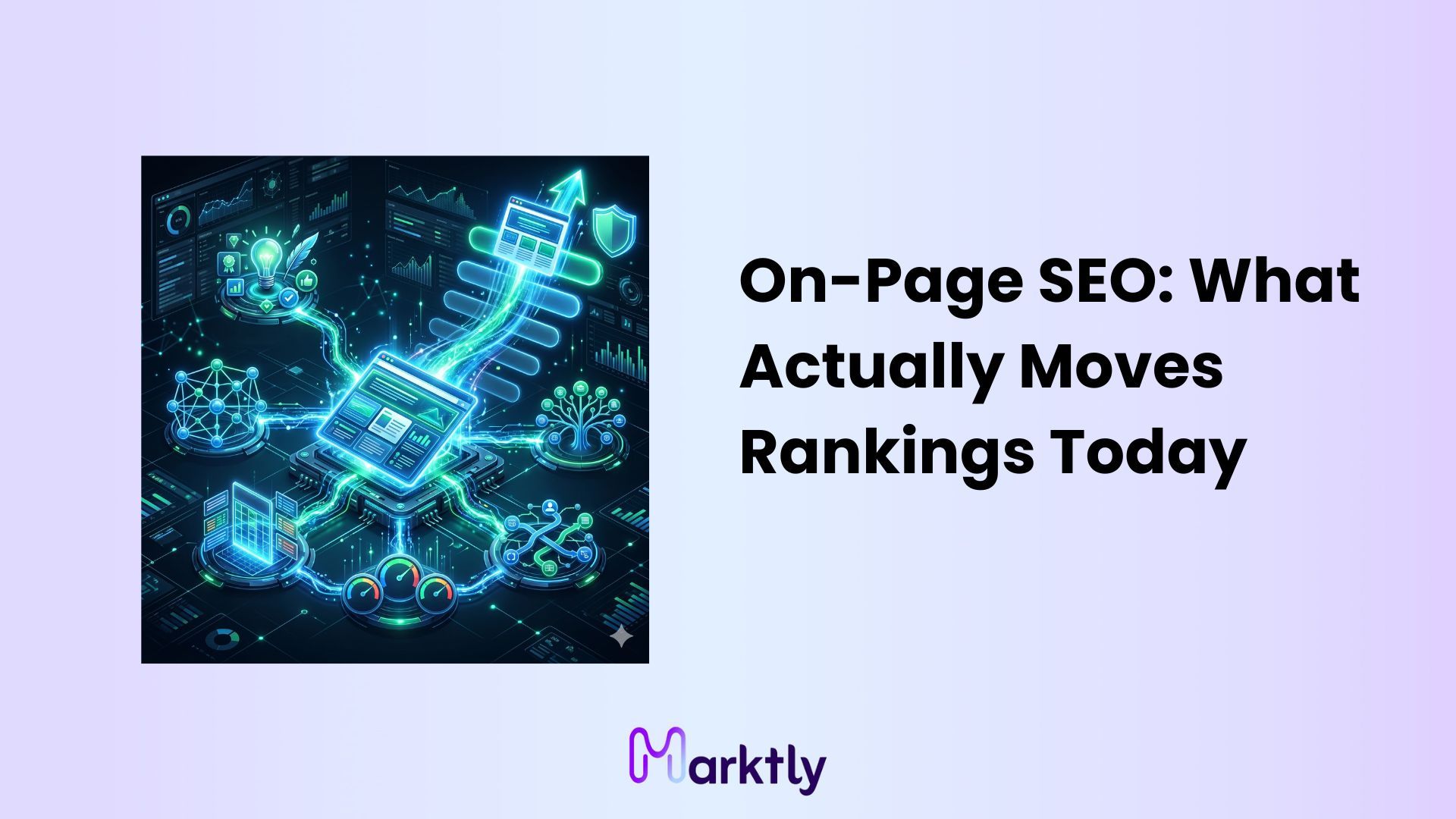
Ranking in 2026 isn't about stuffing keywords into your title tag and calling it a day. Google's gotten smarter, a lot smarter. Today, a page ranks because it acts as an authoritative utility: it gives the searcher exactly what they came for, faster and more completely than anyone else. That's the new standard.
Here's the uncomfortable truth: meta tag tweaks and keyword density are table stakes now. Everyone does them. Real ranking growth comes from two things: Information Gain (do you add something new to the conversation?) and intent mapping (are you actually answering what the searcher wants?). If you skip either, you're building on sand.
So in this article, we're going to walk through the five things that genuinely move rankings today. Not a checkbox list. A framework. Prioritize content depth and technical stability, or Google's "thin content" filter will quietly bury you and you won't even know why.
Intent Matching vs. Keyword Matching
Search Intent is the single most important ranking driver in 2026 full stop. It's not about whether your keyword appears in the H1. It's about whether your entire page answers the goal behind the search. Google doesn't evaluate pages the way humans do. It evaluates signals associated with user satisfaction and content quality.
That said, keywords still signal context. The smart play is to use NLP-relevant terms to reinforce what your page is about not to hit a density percentage. Think of them as vocabulary that confirms your page belongs in a conversation, not a magic formula.
Now here's where most articles fall short: they treat "search intent" as a single category. It's not. There are micro-intents hiding inside every query, and missing them means you're writing the wrong page. For example:
- Someone searching "project management software" could be problem-aware (just realizing they need a tool) or feature-evaluating (ready to compare options). Same query. Completely different page structure needed.
- "How to fix INP issues" is pure problem-solving intent that person wants steps, not history.
- "Best CRM for small business" is commercial intent with a comparison sub-intent they want to decide, not just learn.
So what do you do? Before you write a single word, open an incognito tab and look at the top 10 results for your target query. What format dominates lists, how-tos, comparison tables, long-form guides? That's Google showing you what users actually want. Don't fight it. Build for it.
| Intent Type | What the User Wants | Page Elements That Fit |
|---|---|---|
| Informational | Learn something | How-to sections, definitions, examples |
| Navigational | Find a specific thing | Clean structure, fast load, clear branding |
| Commercial | Compare before buying | Comparison tables, pros/cons, reviews |
| Transactional | Buy/sign up now | Clear CTAs, pricing, trust signals |
Get intent right and you've won half the battle. The other half? Making sure Google picks your answer over the ten others who also got intent right.
Engineering Information Gain (IG)
Once intent is matched, the next question is: "Why should Google pick your answer over a competitor's?" This is where Information Gain comes in and it's arguably the most underrated concept in SEO right now.
Information Gain (IG) is Google's mechanism for rewarding content that adds something new to the index. It's not a penalty for being wrong. It's a reward for being original. If your article says the same things as the five articles above you, in roughly the same way you're not gaining anything. You're duplicating. The March 2026 Core Update hit this hard.
E-E-A-T (Experience, Expertise, Authoritativeness, Trustworthiness) is the framework Google uses to assess this. But here's what most people miss: Experience is now a first-class signal. That means firsthand evidence. Screenshots from your own analytics. Data you collected. Opinions you've actually formed from doing the work. A paragraph that starts with "We've run this test across 40 client sites and here's what we found..." carries more weight than the most beautifully cited generic overview.
There's a real difference between template-speak and style instinct. Template-speak is what you get when someone fills in an AI-generated outline: "Search intent is important because it helps Google understand what users want." That's true. It's also useless. Style instinct is when you reframe a known fact so the reader sees it differently: "You're not writing a page. You're answering a specific person at a specific moment of need. Change the frame and your whole structure changes."
That second version makes the reader think. That's what IG actually is.
Want to audit your existing content for IG problems? Here's a quick workflow:
- Pull your top 10 pages by impressions in Google Search Console.
- Check the last-updated date. Anything over 18 months old is a target.
- Identify any stats, claims, or examples that could be outdated. Replace them with current, source-backed data.
- Add at least one original insight per section, something from your own experience, testing, or data that isn't in the top 5 competing articles.
- If a section reads like it could've been written by anyone, rewrite it until it reads like it was written by you.
This isn't a one-time fix. It's a content maintenance habit.
Passage Architecture for AI Discovery
High-value insights are useless if crawlers can't extract them. Structure must follow logic and in 2026, that means structuring for both human readers and AI systems that synthesize content for AI Overviews, featured snippets, and voice search.
Passage Architecture is the practice of writing self-contained, 100–200 word sections that can be read in isolation and still make complete sense. Think of each H2 section as a mini-article. If someone reads only that section, they should walk away with a complete answer to one specific question.
The 70-word rule is a practical application of this: for any informational header, put a direct, quotable answer in the first 70 words. Why? Because AI systems scrape that opening for synthesis. If your answer is buried in paragraph four, it won't get cited. It's that simple. Place the direct answer at the top, then expand below.
Q&A formatting is your friend here. When you structure a section as an implicit question-and-answer, AI systems can extract the response cleanly for featured snippets and spoken search results. You don't need to literally write "Q:" and "A:" just make sure each header implies a question and the opening paragraph answers it directly.
Schema markup closes the loop on this. Use JSON-LD to implement FAQ, Article, or Review schema depending on your page type. This isn't just for rich results, it's how you communicate context to machine crawlers that don't read, they parse. FAQ schema in particular tells Google: "These questions and answers are discrete, extractable units of information." That's exactly what you want.
One more thing that's easy to overlook: terminology consistency. If you call it "bounce rate" in section one and "exit rate" in section three, AI systems may treat them as different concepts. Pick your terminology and stick to it throughout. Consistent language = higher LLM citation rates. Not a huge lift, but it matters.
Engagement Signals and Goal Completion
Ranking for a snippet or LLM result is the first step. Keeping the user on-page determines long-term ranking stability. Google watches what happens after the click.
Goal Completion is the moment a user finds the answer they were looking for and ends their search journey on your page not by bouncing back to Google to look elsewhere, but by genuinely getting what they came for. It's the on-page equivalent of a closed sale. This is what all engagement optimization is really pointing toward.
The opposite of Goal Completion is pogo-sticking: the user clicks your result, spends 12 seconds on the page, hits back, and clicks the next result. That's a clear signal to Google that your page failed. It doesn't just hurt that session it accumulates. Enough pogo-sticking and your ranking quietly drops, regardless of how many backlinks you have.
Interactive elements reduce this. Accordions for long FAQ sections, comparison tables for feature-heavy content, embedded calculators, short videos that explain concepts these all do two things. They increase dwell time (the user is engaging, not just scrolling) and they improve cognitive comprehension (the user actually understands the content, making Goal Completion more likely).
Here's something most analytics dashboards still miss: Adjusted Bounce Rate and Scroll Depth Triggers give you a far more accurate picture than raw bounce rate. A user who reads 80% of your 2,000-word article and bounces is not the same as one who bounced in 8 seconds. Set up scroll depth events in Google Analytics 4 (the 25%, 50%, 75%, 90% thresholds) to see where users are actually dropping off. Then fix that section, not a random one.
Goal Completion checklist:
- Does the page answer the query within the first 200 words?
- Is there a clear next step (CTA, related article, tool) after the answer?
- Are CTAs specific and low-friction (not "Contact Us" more like "Download the free checklist")?
- Are ads or pop-ups interrupting the reading flow before the user gets the answer?
- Does the mobile layout preserve the content hierarchy, or does it collapse into a mess?
- Is the primary answer scannable (short paragraphs, subheadings, bullet points)?
One thing worth saying directly: ads and pop-ups placed above the fold, before the user has gotten any value, are a direct engagement tax. If you need them, fine. But put them below the answer, not between the user and the answer.
Technical On-Page Usability (INP Focus)
The most engaging content fails if the interface is slow or jumpy. That's why technical performance isn't a separate silo from content, it's the credibility foundation everything else sits on. A page that loads in 4 seconds with a janky layout is a page users abandon before your Information Gain has a chance to land.
The headline metric for 2026 is Interaction to Next Paint (INP). This replaced First Input Delay (FID) as the Core Web Vital measuring responsiveness. INP measures the time between a user interaction (click, tap, keypress) and the next visual update. The threshold:
| INP Score | Status |
|---|---|
| Under 200ms | Good ✓ |
| 200ms – 500ms | Needs improvement |
| Over 500ms | Poor ranking risk |
Most sites fail INP because of heavy JavaScript executing on the main thread. The fix isn't always rewriting your whole site; often it's deferring non-critical scripts, breaking up long tasks, and prioritizing rendering of above-the-fold content. Start with the PageSpeed Insights "Diagnose performance issues" section, which now surfaces INP-specific bottlenecks.
Mobile Parity matters more than ever. Google's mobile-first index means the mobile crawler's view of your page is the page, as far as ranking is concerned. If your mobile version hides content behind "tap to expand" by default, or collapses sections that are visible on desktop, Google may not index that content at all. Every element that matters for ranking must be visible and accessible on mobile without interaction.
For image optimization, switch to WebP or AVIF formats if you haven't already. AVIF in particular can reduce image file sizes by 50% compared to JPEG with no visible quality loss. Smaller images = faster Largest Contentful Paint (LCP). LCP should hit under 2.5 seconds on mobile. If it's over 4 seconds, that's a ranking flag.
For Cumulative Layout Shift (CLS) the jittery-page metric keeps it under 0.1. The most common culprits are images without declared dimensions, embeds that load late, and web fonts that cause text reflow. Fix dimensions on all images, preload critical fonts, and use font-display: swap to prevent invisible text during load.
Where to start: Open Google Search Console → Core Web Vitals report → filter by "Poor URLs" → fix INP and CLS issues first. PageSpeed Insights gives you field data (real users) vs. lab data (simulated) and always prioritize field data fixes, as those reflect actual user experience.
Putting It Together
Let's quickly recap what we covered, because it matters that these five things connect; they're not independent checkboxes.
- Intent Matching: Understand the micro-intent behind the query before you write a word. Use SERP analysis to confirm content format.
- Information Gain: Add something genuinely new original data, first-hand experience, reframed perspectives. Don't just re-summarize what's already ranking.
- Passage Architecture: Structure content in self-contained 100–200 word sections. Lead with the direct answer. Use Schema to clarify context for AI systems.
- Engagement Signals: Optimize for Goal Completion, not just dwell time. Use Scroll Depth tracking to find real drop-off points.
- Technical Usability: Hit INP under 200ms, LCP under 2.5s, CLS under 0.1. Mobile Parity is non-negotiable.
Here's the honest pain point most SEOs feel right now: you can do everything right on a single page and still not rank if the overall site fails on technical usability or if the content reads like it was assembled from a template. Google is getting better at detecting genuine depth. The bar keeps rising.
What to do next:
- Audit your top 10 pages for Information Gain gaps (are there facts or sections that any writer could've produced?)
- Run a Core Web Vitals check on your highest-traffic pages in Google Search Console
- Pick one page and restructure it using the Passage Architecture principles direct answer first, 70 words, JSON-LD schema
- Set up Scroll Depth triggers in GA4 if you haven't yet
On-page SEO in 2026 rewards practitioners who think like engineers, not editors. You're not polishing prose. You're building a system that satisfies a user's goal and signals that satisfaction clearly to both algorithms and AI systems. Do that consistently, and rankings follow.
Read More Articles
Ready to create content with Marktly?
Start publishing smarter with AI-powered content workflows and seamless CMS integrations. Everything you need to go live